
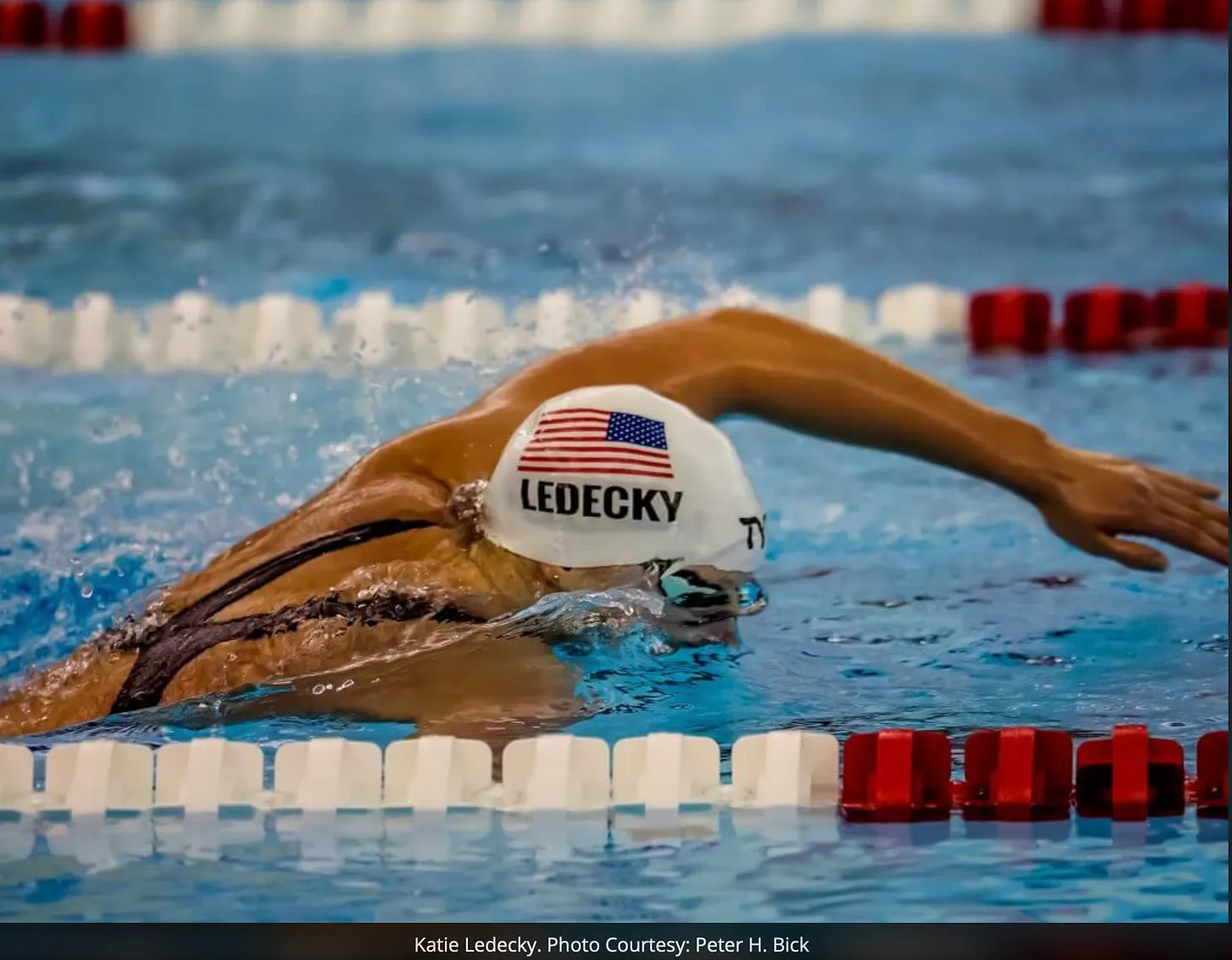
Opening: Why She’s Interesting as a Training Case
Katie Ledecky is often framed as an outlier – someone so dominant that normal analysis stops applying. From a training perspective, she’s interesting for the opposite reason. Her success comes less from novelty or reinvention, and more from sustained execution inside a demanding system.
What makes her especially worth studying now isn’t her medal count – it’s her durability. Few athletes in any endurance sport have remained world-class across so many competitive cycles while keeping the core of their training philosophy largely intact. Her career shows what happens when adaptation is allowed to compound instead of being constantly interrupted.
This is not a story about perfection – and treating it as one would make it useless. There were seasons where the gap closed, moments where she looked human, and phases where adjustment was necessary. That is precisely what makes her training model usable rather than mythical – especially for coaches and athletes trying to build systems that last longer than a single season.

Athlete and Coach: Training Context, Not Biography
Ledecky’s training philosophy was shaped early in an environment that valued process over outcome. From the beginning, the focus wasn’t on racing brilliance, but on repeatability: the ability to execute quality work day after day, even when tired.
A defining factor was her long-term collaboration with Bruce Gemmell, spanning from her teenage years through multiple Olympic cycles. In a sport where coaching changes are common and reinvention is often mistaken for progress, their sustained partnership enabled:
Slow, uninterrupted aerobic development
Trust in monotonous, high-volume work
Refinement rather than constant change
The relationship functioned less as top-down instruction and more as joint problem solving – around workload, recovery, and race modelling. Winning was treated as a by product of training habits, not the objective itself.
Later in her career, the move to Anthony Nesty at Florida represented evolution rather than rejection. The foundation remained intact, but with:
Slightly more attention to race speed
Subtle technical efficiencies
Better integration of recovery as training demands and life outside the pool evolved
Training Volume & Focus: Then vs Now
Youth (Junior / Early Senior)
Weekly Volume
Ages ~10–12: ~20–40 km/week
Ages ~13–14: ~40–50 km/week
Age 15: ~60–70 km/week during peak phases
This was a gradual, deliberate buildup. Volume increased steadily year over year, avoiding spikes and prioritizing long-term aerobic development over short-term results.
Intensity Character
Strongly aerobic-focused
Long, controlled repeats
Descending and pacing-based sets
Technical discipline under fatigue
Even early on, speed was never treated as a separate pursuit – it existed only within the context of aerobic work. It was embedded, not isolated. Purposeful, not dominant.
Peak Development (Mid-Teens → Early Elite Years)
What Changed
Volume stabilized at its highest levels (~60–70 km/week)
Training became more event-specific (800m / 1500m)
Pacing precision and threshold integration increased
Dryland became more structured and intentional
What Increased / Decreased
⬆ Aerobic base reinforced by threshold work
⬆ Race modeling and pace control
⬇ Unfocused speed variety, replaced by purpose-built intensity
This phase was about specialisation – not adding more, but sharpening what already existed.
Later Career (~2025–2026 Context)
Weekly Structure (Inferred)
~10 swim sessions per week
~5 strength / dryland sessions per week
Exact weekly kilometres are no longer publicly emphasised – and that’s telling. The priority has shifted from volume as a number to volume as a managed tool.
Current Emphasis
Sustaining a high aerobic base while protecting recovery
Integrating speed and race pace without burnout
Psychological sustainability through a shift in motivation – from chasing medals to chasing performance on her own terms (“want times”)
What She Has Kept
A massive aerobic foundation
A process-oriented mindset
Comfort with routine and repetition
What She Has Adapted
Less emphasis on volume chasing
Greater attention to recovery, balance, and long-term output
Increased selectivity in where intensity is applied

Training Philosophy: The Connecting Thread
Before looking at individual sessions, three principles explain almost everything in Ledecky’s training – and they hold up across every stage of her career:
Consistency > Variation
Progress comes from repeating demanding work year after year. Adaptation compounds when the system remains stable.
This principle is scalable: whether training 20k or 70k per week, stability enables adaptation.
Aerobic Foundation > Intensity
Speed is layered on top of endurance. It is expressed under fatigue, not trained in isolation.
Simplicity > Complexity
Sets are clear and purposeful. Difficulty comes from execution, not from complicated structures.
This is a model that rewards execution, not novelty.
These principles link her youth development, peak dominance, and late-career sustainability into a single, continuous model – not a formula, but a long-term logic.
Transition Into the Series
In the next posts, I’ll break down several training sessions and set structures this athlete returns to again and again – not because they are flashy, but because they reliably produce adaptation.
The goal is not to copy elite volume, but to understand why repetition, restraint, and patience outperform novelty over time – and how that logic can be adapted without breaking the system.
Leave a Reply